

The conference floor moves fast. Attendees scan booths, collect materials, take meetings, and make snap judgments about which brands feel credible, prepared, and worth remembering. That is why choosing the best branded gifts for conferences is not a small detail. The right item can extend your brand presence long after the event ends, while the wrong one becomes waste before the day is over.
For marketing teams, procurement leads, and event organizers, the real question is not simply what looks good with a logo. It is what supports business goals. A conference gift should match the audience, fit the event environment, stay within budget, and deliver enough practical value that people keep it. The strongest choices do all four.
What makes the best branded gifts for conferences?
A good conference giveaway earns its place. It should be useful on-site or immediately after the event, easy to carry, and aligned with your brand image. If your item creates inconvenience, feels cheap, or has no clear use case, it works against you.
Practicality usually wins over novelty. A compact power bank, a quality notebook, or a drink bottle often outperforms a flashy gadget because attendees can use it right away. The gift becomes part of their day, and your brand stays in view naturally rather than forcing attention.
Quality also matters more than many buyers expect. One well-made item creates a better impression than a bag full of forgettable ones. Conference audiences include decision-makers, buyers, partners, and media contacts. The products you hand out reflect how you operate.
1. Reusable drinkware
Drinkware remains one of the safest and strongest choices for conference gifting. Water bottles, tumblers, and insulated mugs have broad appeal, a long usable life, and enough surface area for tasteful branding. They also support sustainability messaging better than single-use items.
This category works especially well for all-day conferences, trade shows, and leadership summits where attendees move between sessions. A bottle or tumbler becomes part of the event itself. That repeated use builds visibility without feeling promotional.
The trade-off is cost. Better drinkware is not the cheapest option, and cheap versions can backfire if they leak or feel flimsy. If you choose this route, prioritize build quality and clean branding.
2. Tote bags that people actually reuse
Tote bags are a conference staple for a reason. Attendees need something to carry brochures, samples, notebooks, and personal items. A well-designed tote solves a real problem on the spot, which makes it more likely to stay with them after the event.
The difference between a keeper and a throwaway usually comes down to material, size, and design. A sturdy bag with comfortable handles and a modern layout feels useful beyond the event. An oversized logo on a thin bag often does not.
Totes are also effective when paired with printed inserts, catalogs, or welcome packs. For brands managing multiple touchpoints, they can act as packaging and promotion in one item.
3. Notebooks and premium pens
If your audience includes executives, educators, procurement teams, or corporate delegates, notebooks and pens still perform well. They fit naturally into conference behavior because people take notes, write follow-ups, and jot down contact details throughout the day.
The best results come from treating these as a set rather than an afterthought. A soft-touch notebook paired with a smooth-writing pen feels intentional and professional. It is especially suitable for seminars, training events, panel sessions, and institutional conferences where practical use matters more than novelty.
This category is less exciting visually, but that can be a strength. It signals professionalism and consistency, which is often exactly the message a serious brand wants to send.
4. Tech accessories with everyday value
Few categories feel more relevant at conferences than tech accessories. Phone stands, charging cables, webcam covers, wireless chargers, and compact power banks address real needs for attendees who spend the day on devices.
Among the best branded gifts for conferences, tech items stand out because they combine utility with modern brand positioning. They suggest a business that understands how people work. For technology, finance, education, and B2B service brands, that alignment is powerful.
Still, this is where sourcing discipline matters. Low-grade tech can fail quickly, and that failure reflects directly on your brand. Compatibility, safety standards, packaging, and print durability should all be checked before approval.
5. Lanyards and badge accessories
Not every conference gift needs to be a premium keepsake. Sometimes the smartest branded item is one that integrates directly into the event experience. Lanyards, badge holders, retractable reels, and card sleeves are useful from the moment attendees arrive.
These items are often overlooked because they feel operational rather than promotional. In reality, they deliver high visibility across the venue. Every attendee, exhibitor, and speaker sees them repeatedly, making them one of the most cost-efficient branding tools for large events.
They work best when branding is clean and event-focused. If the design feels too sales-driven, the item can look cluttered. Keep it simple and professional.
6. Travel-friendly pouches and organizers
Conference attendees are usually carrying cables, cards, stationery, passes, and small personal essentials. A compact organizer pouch or travel wallet can solve that clutter in a simple, useful way.
This category is especially strong for premium conferences, regional events, and executive audiences. It has a more polished feel than standard giveaways and supports a businesslike image. Brands that want to be seen as organized, capable, and detail-oriented benefit from that association.
The key is functional design. Too many compartments can feel bulky, while poor material choice makes the item feel disposable. Aim for something sleek enough to fit into a work bag.
7. Desk accessories for post-event brand recall
The conference may last one or two days, but your branded item should work longer than that. Desk accessories such as mouse pads, cable organizers, pen holders, or mini desktop calendars remain visible in offices and home workspaces after the event is over.
These products are less useful during the conference itself, so they are better for curated gift packs or targeted distributions rather than mass booth giveaways. When matched to the right audience, they support ongoing recall in a subtle but consistent way.
This is a smart category for brands focused on longer sales cycles. If your conversions happen weeks after the event, a desk item can keep your name in view while follow-up conversations continue.
8. Eco-conscious gifts with real function
Sustainability claims are easy to print and harder to prove. If your brand wants to position itself responsibly, choose eco-conscious gifts that are also clearly useful. Recycled notebooks, reusable utensil sets, bamboo accessories, and wheat-straw stationery can work well when quality and purpose are both present.
The important point is authenticity. A sustainable message paired with a product that nobody uses feels contradictory. The item should reduce waste through repeated use, not simply borrow eco language for packaging.
When done well, this category supports both brand values and attendee expectations, particularly at universities, public sector events, and organizations with ESG priorities.
9. Apparel, but only when the fit is right
T-shirts, caps, and light outerwear can be effective conference merchandise, but they are more selective than many buyers assume. Apparel works best when the design has standalone appeal and the audience is likely to wear it beyond the event.
For employee teams, volunteer crews, and sponsored activation staff, branded apparel helps with visibility and coordination. For attendees, it is riskier. Sizes, style preferences, and logo placement all affect whether the item gets used.
If you want wearable branding for attendees, caps and socks often offer a safer middle ground than T-shirts. They are easier to size and can feel more premium when designed well.
10. Snack gifts and consumables
Branded snacks, mints, coffee sachets, and treat boxes can create a quick positive impression, especially at long events where attendees appreciate a practical pick-me-up. They also work well in hotel welcome kits, VIP sets, and meeting-room drops.
The limitation is obvious. Consumables do not provide lasting visibility in the same way as drinkware or tech items. They are best used as part of a broader gifting strategy rather than the only touchpoint.
That said, for high-volume events with tight budgets, a well-packaged consumable can still be effective. It feels generous, immediate, and easy to distribute.
11. Customized welcome kits
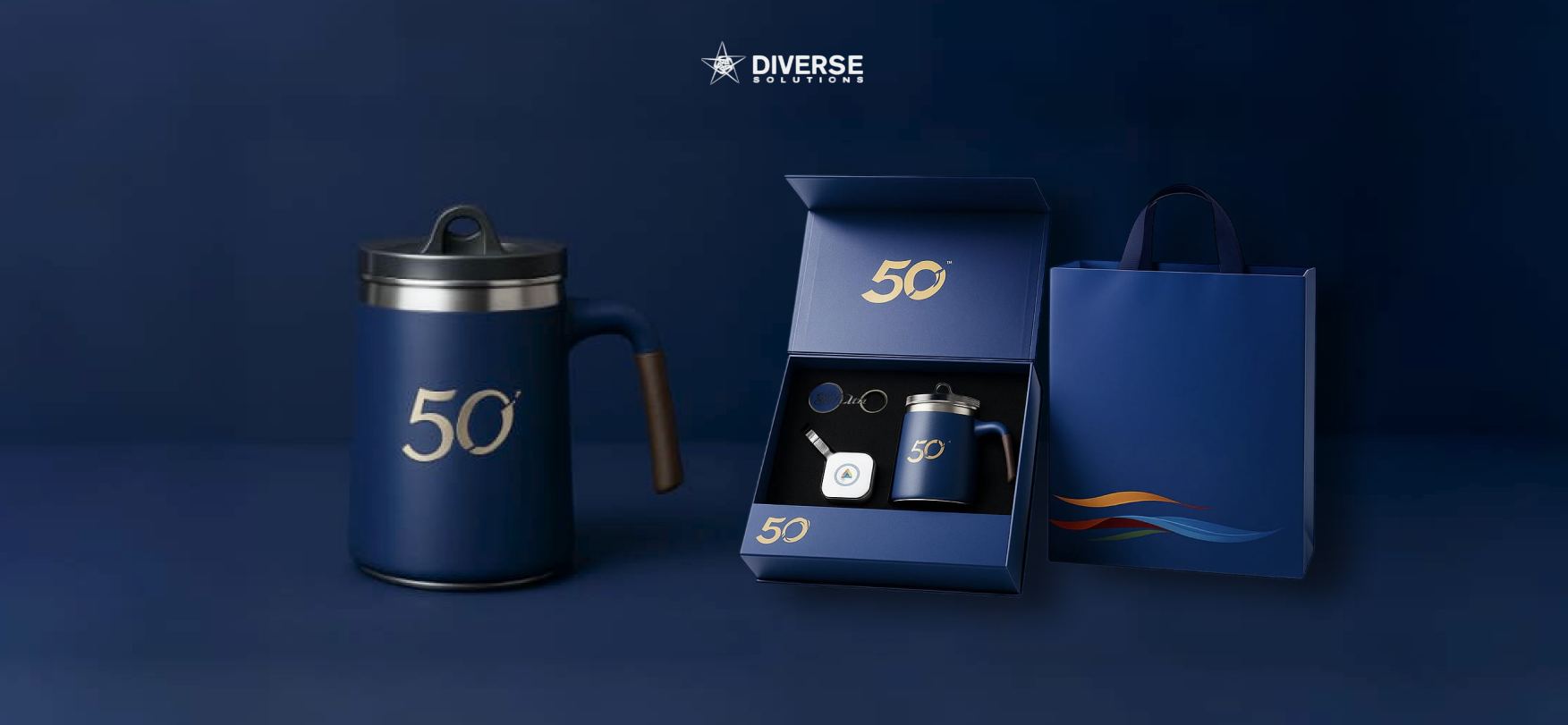
If you are sponsoring a conference, running an internal summit, or hosting delegates, a welcome kit can deliver stronger impact than a single giveaway item. Combining a few well-chosen products such as a notebook, bottle, badge accessory, and printed event materials creates a more complete brand experience.
This approach is particularly valuable for organizations that want consistency across merchandise, print collateral, signage, and event presentation. It gives buyers tighter control over branding and allows every component to support a unified message. That one-vendor coordination is where experienced partners such as Diverse Solutions Singapore add real efficiency.
The trade-off is budget and logistics. Kits require more planning, packing, and inventory control. But for flagship events, the payoff in presentation and perceived value can be substantial.
12. Premium gifts for VIPs and key prospects
Not every attendee should receive the same item. For VIP guests, speakers, partners, and high-value prospects, a more premium gift can be the right move. Executive pens, high-end drinkware, leatherette organizers, or curated desk pieces can elevate the relationship and signal intent.
The key is discretion. Premium gifting should feel thoughtful, not excessive. It should also match the nature of the event and the stage of the business relationship. A gift that is too expensive for the context can create discomfort instead of goodwill.
How to choose the right conference gift for your event
The best choice depends on what success looks like for you. If your goal is booth traffic, practical low-friction items work well. If your goal is post-event recall, choose something with a longer desktop or daily-use life. If the event is premium, your gift should match that standard.
Audience profile matters just as much. Students, corporate buyers, technical delegates, and government attendees do not respond to the same products in the same way. Budget matters too, but unit cost should never be the only filter. A cheaper item that gets discarded immediately is often more expensive in brand terms than a better product distributed strategically.
A strong conference gift does not just carry your logo. It carries your standards, your positioning, and your ability to think through the attendee experience. Choose something people will keep, use, and remember – and your brand keeps working after the booth comes down.
