

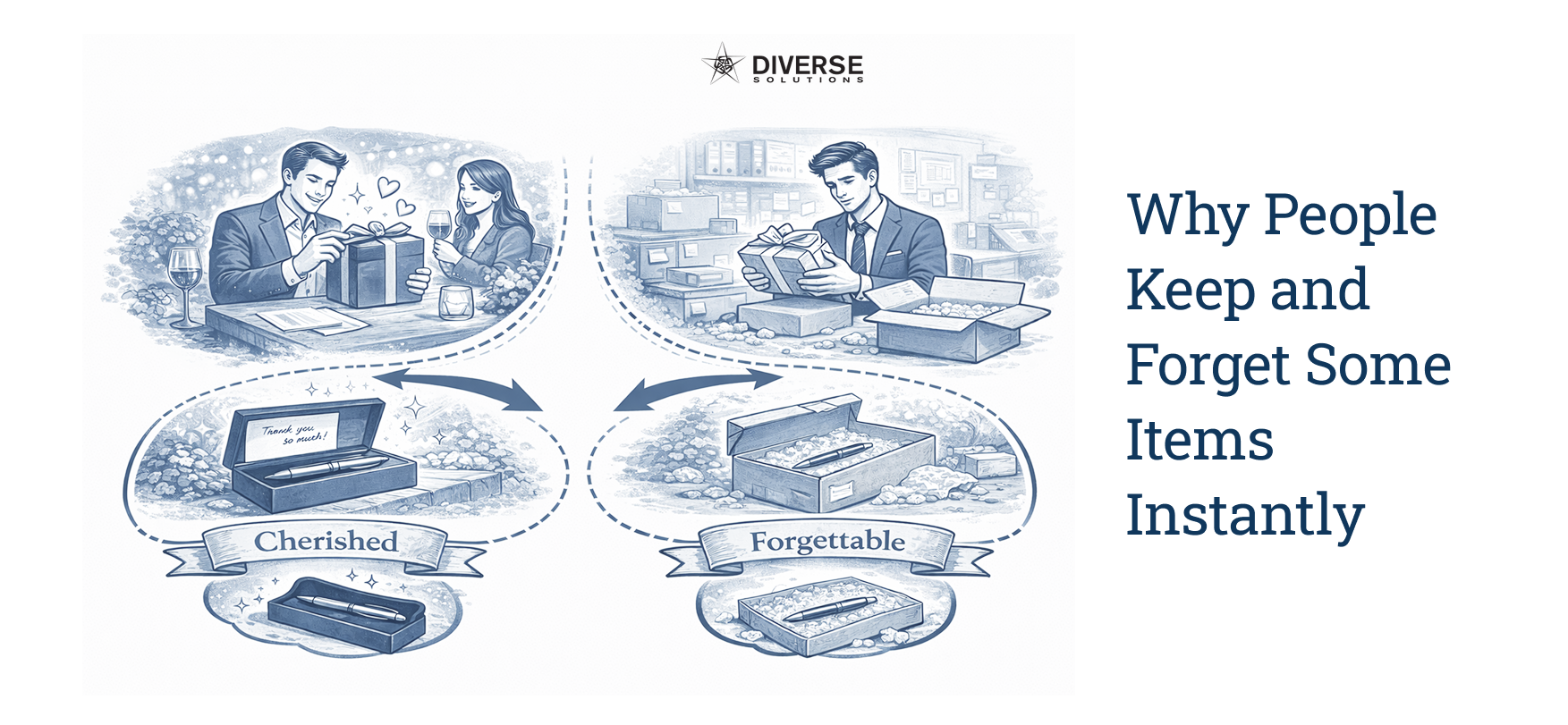
Product Perception: It’s Not About the Item
Have you ever noticed how some items stay on your desk for years, while others disappear almost immediately?
It’s easy to assume the difference comes down to price or function. But in reality, the deciding factor is something less visible—how the item is experienced.
Because what people receive is never just an object. It’s an interpretation.
Why Two Identical Items Can Feel Completely Different
Two items with the same cost and purpose can create very different impressions.
On which, one may feel:
- Generic
- Forgettable
- Easily replaceable
However the other feels:
- Thoughtful
- Intentional
- Worth keeping
Then, the difference lies not in the item itself, but in how it is perceived. Subtle cues—often unnoticed—shape this Product Perception:
- The way it looks
- The way it feels in hand
- The context in which it is received
These small details influence how people assign value, even without conscious awareness.
How Experience Shapes Meaning
People don’t evaluate things purely based on their physical attributes. They evaluate them based on the experience surrounding them.
This includes:
- The moment of receiving
- The environment or setting
- The emotional context attached to it
When these elements align, the item becomes more than functional—it becomes meaningful. Moreover, meaning is what drives retention.
Why Some Things Stay—and Others Don’t
Items are kept not because they exist, but because they resonate. Then, people tend to hold on to things that:
- Fit naturally into their daily routines
- Feel aligned with their personal or professional identity
- Carry a sense of intention behind them
On the other hand, items that lack these qualities are quickly forgotten—regardless of their cost.
The Role of Small Details in Shaping Perception
What often goes unnoticed has the greatest impact.
Elements such as:
- Material quality
- Visual consistency
- Practical usability
- Presentation and delivery
…work together to influence how something is interpreted.
These details act as signals—subtly communicating value, care, and intention.
When overlooked, the experience feels incomplete.
When carefully considered, the impact becomes lasting.
From Object to Meaningful Experience
The most memorable items are not defined by what they are, but by what they represent.
Furthermore, they reflect:
- Attention to detail
- Thoughtful consideration
- A consistent and intentional experience
This transformation—from object to meaning—is what determines whether something is kept or forgotten.
Conclusion
In the end, people don’t respond to objects themselves. They respond to what those objects mean to them. And that meaning is shaped by experience, context, and detail. The smallest touchpoints often leave the strongest impressions— not because they are bigger, but because they are more intentional.
For more information and to explore our offerings, visit Diverse Solutions Singapore.
