

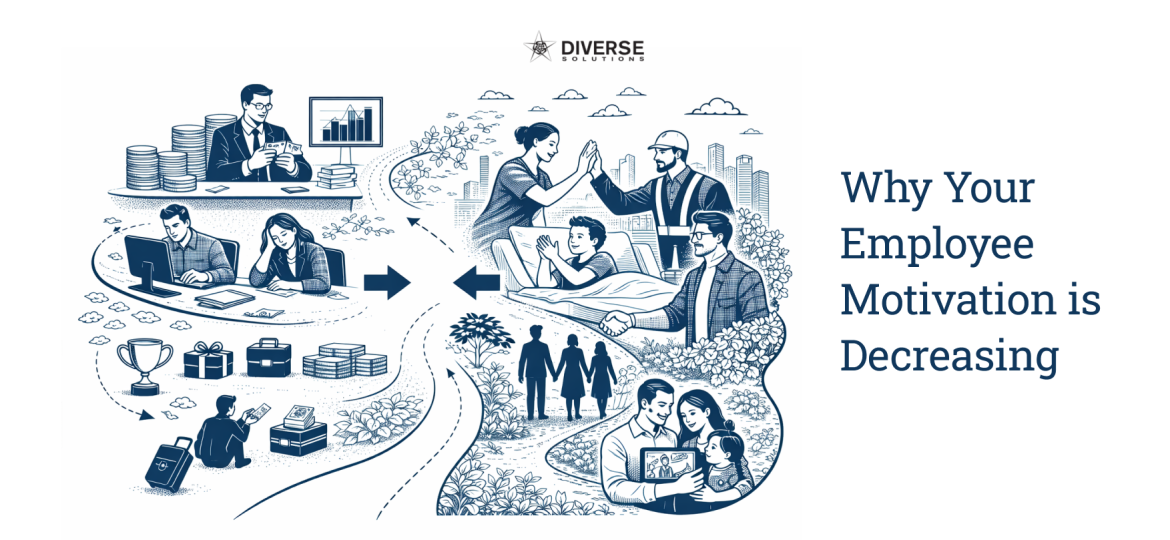
Every year, companies spend billions on compensation packages, wellness programs, and performance bonuses — all in the hope of keeping employees motivated and engaged.
And yet, according to Gallup’s ongoing research, the majority of employees worldwide remain disengaged at work.
So if money isn’t the answer, what is?
The research points to something far simpler — and far more overlooked.
People need to see that their work matters.
What Adam Grant’s Research Actually Found
Adam Grant, organizational psychologist at the Wharton School of the University of Pennsylvania, has spent years studying the psychology of employee motivation in the workplace.
In a landmark study published in the Academy of Management Journal (2012), Grant investigated what happens when employees have direct contact with the people who benefit from their work — what he calls beneficiary contact.
The results were striking.
Across multiple industries and job types, employees who were connected to the real human outcomes of their work showed significantly higher employee motivation and job performance — even when nothing structural about their role had changed.
Employees have same job. Same pay. Same manager.
But performance improved — because meaning became visible.
The Psychology Behind It: Task Significance
Grant’s findings connect directly to a foundational concept in organizational psychology: Task Significance.
First introduced by Richard Hackman and Greg Oldham in their Job Characteristics Model (JCM) in 1976, Task Significance refers to the degree to which a job has a substantial impact on the lives of other people — whether inside or outside the organization.
According to the JCM, jobs that score high on Task Significance trigger a critical psychological state in employees: they experience their work as meaningful.
And meaningful work, the research consistently shows, leads to:
- Higher intrinsic employee motivation
- Greater job satisfaction
- Stronger organizational commitment
- Lower turnover and absenteeism
The problem is that in most modern organizations, the connection between an employee’s daily tasks and their real-world impact is invisible.
A software engineer doesn’t see the small business owner whose company survived because their platform worked. A corporate event planner doesn’t see the employee who felt genuinely valued for the first time because of a well-executed team celebration. A designer doesn’t see the client who won a major pitch because their presentation looked exceptional.
The impact is real. But it stays hidden.
Why Visibility Is the Missing Link
Grant’s research adds a crucial layer to what Hackman and Oldham originally proposed.
It’s not enough for a job to theoretically have significance. Employees need to experience that significance directly and personally.
This is why beneficiary contact is such a powerful intervention. When employees meet, hear from, or even simply learn about the specific people their work has helped, the abstract becomes concrete. The distant becomes personal. The task becomes a contribution.
In Grant’s studies, even a brief, five-minute interaction with a beneficiary was enough to produce measurable improvements in performance.
The implication for leaders and organizations is profound:
Employee Motivation is not primarily a compensation problem. It is a meaning-visibility problem.
The Modern Workplace Gap
Despite decades of research supporting these findings, most organizations continue to manage motivation the wrong way.
They default to what is measurable and transactional — salaries, bonuses, KPIs, and performance ratings — while neglecting what is experiential and relational.
Recognition, when it happens at all, tends to be:
- Generic (“great work this quarter”)
- Invisible (a message buried in a Slack channel)
- Forgettable (a certificate no one frames)
None of these approaches make impact felt. They acknowledge results without connecting people to the human meaning behind those results.
And according to the research, that connection is precisely what drives sustained motivation.
What Leaders Can Do Differently
Translating Grant’s research into practice doesn’t require a complete organizational overhaul. It requires a shift in how leaders think about recognition, communication, and experience design.
Here are three practical approaches:
- Make Beneficiary Stories Part of Your Culture
Regularly share stories — in team meetings, internal newsletters, or company events — that illustrate the real human impact of your team’s work. Who did you help? What changed for them because of what your team did?
This doesn’t need to be elaborate. A two-minute story at the start of a meeting can reframe how an entire team sees their work for weeks.
- Design Experiences That Reinforce Meaning
Recognition events and team gatherings are often treated as logistical necessities. But when designed intentionally, they become powerful tools for making impact visible and felt.
A well-designed company event that tells the story of your team’s achievements — grounded in the real outcomes they created for real people — does more for motivation than a generic year-end party ever could.
- Make Recognition Tangible and Intentional
The medium of recognition matters because people remember experiences, not announcements.
When recognition takes a physical, thoughtful, and personalized form — a carefully chosen gift, a meaningful keepsake, something that carries the weight of what it is trying to say — it reinforces the message in a way that a digital notification simply cannot.
This is not about extravagance. It is about intentionality. A gift that says “we see what you contributed, and it mattered” lands differently than one that says “here is your end-of-year token.”
The Broader Lesson for Organizations
Adam Grant’s research, alongside decades of work in organizational psychology, points to a consistent and actionable truth:
The most powerful motivational tool available to any leader is not a bigger budget. It is a clearer connection between work and meaning.
When employees can see — directly and vividly — that what they do matters to real people, something fundamental shifts. Work stops being a transaction and starts being a contribution.
Building that visibility doesn’t happen by accident. It requires deliberate choices about how you communicate, how you recognize, and how you design the experiences that shape your team’s sense of purpose.
The organizations that get this right don’t just have more motivated employees. They have people who show up differently — with more energy, more commitment, and more pride in what they do.
Conclusion
Motivation is not a trait that some employees have and others don’t. It is not primarily a function of how much someone is paid.
It is, as the research shows, a result of design.
Design how your team experiences the impact of their work. Make meaning visible. Make recognition feel like what it is supposed to feel like.
And watch what happens to performance.
For more information and to explore our offerings, visit Diverse Solutions Singapore.
